

Exercise as Prevention and Treatment of Heart Disease
The exceptional economic growth and continuous modernisation of Asia, Hong Kong included, has brought about increasing risk factors and incidence of coronary heart disease (CHD). (1) In 2015, heart diseases accounted for the third most common cause of death in Hong Kong, with CHD being the largest contributor to the statistics at 66.6% of all heart disease deaths. (2) The term "heart disease" comprises a wide range of diseases that affect the heart, while "coronary heart disease" refers to disease of the coronary arteries that supply the heart. This occurs when the coronary arteries that supply oxygen to the heart narrow due to cholesterol deposits in the inner walls, affecting the oxygen flow to the cardiac muscle and leading to arm and chest pain or, in severe cases, a heart attack. (2,3)
Non-communicable diseases (NCDs) — including heart disease, diabetes, cancer and chronic respiratory disease — are a global burden on the human population according to the WHO, making up 70% of all global deaths and 55% of all registered deaths in Hong Kong. Given a health-positive physical and social environment, a third of these cases can be prevented through lifestyle choices. The primary lifestyle factor that we will focus on in this article is physical inactivity, which remains a public health issue. (4) Physical inactivity is a primary factor for ischemic heart disease (30%) and is a risk factor for heart diseases. (4,5)
According to Japan's Exercise and Physical Activity Guide for Health Promotion in 2006, physical activity, as a general term, is described as bodily movements that require a higher level of energy expenditure than the resting energy expenditure. It categorises physical activity into "exercise" and "non-exercise activity" (NEA). Exercise is a purposeful physical activity that is done repetitively to maintain one's physical fitness, such as jogging, swimming and cycling. NEA, on the other hand, covers physical activities that are not usually regarded as exercise, such as playing with children, walking to work and gardening. This also includes occupations that require you to be physically active, such as tour guides, teachers and surgeons. (6)
The recommendation by the World Health Organisation (WHO) states that adults aged 18 or above should perform at least 150 minutes of moderate-intensity aerobic activity or 75 minutes of vigorous-intensity aerobic activity, or an equivalent combination of moderate and vigorous-intensity aerobic activity, per week. Exercise should be performed at least 30 minutes a day, on most days, and it can be divided into bouts of at least 10 minutes each time, 3 times per day. (9) The intensity of physical activity can be measured in METs, which are units of metabolism. For example, at rest, a person will spend 1 MET of energy to maintain normal body functions. (8) For a wide range of physical activities and their MET reference values, please refer to the compendium of physical activities by Ainsworth and colleagues.
Based on scientific research, there is strong evidence of a dose-response relationship between the frequency, intensity, duration and volume of physical activity and the risk of cardiovascular disease. To lower cardiovascular risk significantly, the evidence suggests that at least 150 minutes per week of moderate to vigorous intensity physical activity is required. (9) Furthermore, dynamic aerobic endurance training has evidently lowered blood pressure in certain hypertensive groups, with a reduction of 8 to 10 mm Hg in both systolic and diastolic blood pressure readings. (11) All-cause mortality — meaning the death rate from all causes of death, including heart disease mortality — also appears to be lower for those who are physically active. The recommendations on physical exercise training in the Canadian Medical Association Journal support this evidence by giving a grade A recommendation for those who do not have hypertension but have established atherosclerotic disease to become physically active, to reduce the risk of cardiovascular disease mortality, re-infarction and death from other causes. (8)
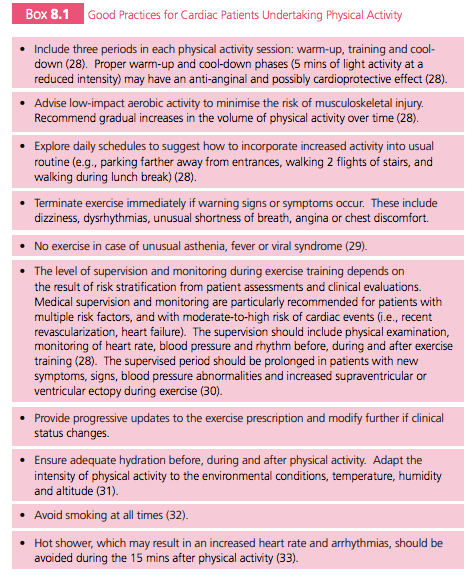
Here are some general guidelines for starting to exercise when you have heart disease. It is best to speak to your healthcare provider before you start any exercise programme. The general recommendation is to start slow and choose a low-impact aerobic exercise such as swimming, jogging or cycling, at least 3–4 times each week. It is recommended to divide the exercise training programme into 3 periods: warm-up, training and cool-down. A proper warm-up and cool-down (at least 5 minutes of light intensity) can have a protective effect on the heart. People with heart disease should be more aware of the weather when exercising outdoors — whether it is too cold or too hot — and dress accordingly. Hydration is an important factor as well; it is advisable to always carry a water bottle to rehydrate when necessary. Resistance training and weight training are also recommended to improve the musculoskeletal system, providing overall health benefits. The key is to start slow with minimal repetitions. As with all exercise, it is essential to listen to one's body and take sufficient rest whenever necessary. Medical attention should be sought when these alarm signs are present: worsening of heart disease, numbness, shortness of breath and lightheadedness. (12,13)
Given the extensive evidence on the benefits of exercise, there remain safety concerns regarding exercise for this population and the risk of a cardiovascular event during exercise. Studies have shown that, compared to otherwise healthy individuals, the risk is higher for those with heart disease. However, the absolute incidence of death during exercise is relatively low. Musculoskeletal injuries, on the other hand, are common, as with any repetitive exercise. (7,8) As a general note, a medical evaluation by the individual's physician and exercise professional, along with pre-participation screening, should be performed adequately by trained exercise professionals to identify problem areas and high-risk individuals. In addition, the training and preparedness of exercise professionals in emergencies are essential and must meet industry standards. In conclusion, the overall health benefits of exercise outweigh the potential risks, which can be reduced significantly through pre-participation screening, medical evaluation and the guidance of a trained exercise professional. (7)
References
- Janus, E.D., Postiglione, A., Singh, R.B. and Lewis, B. (1996). The Modernization of Asia. Circulation, 94(11), pp.2671–2673.
- Centre for Health Protection, Department of Health (2019). Heart Diseases. Available at: https://www.chp.gov.hk/en/healthtopics/content/25/57.html
- Endler, N.S. (2001). Coronary Heart Disease (CHD), Coping with. ScienceDirect. Available at: https://www.sciencedirect.com/science/article/pii/B0080430767038110
- Towards 2025: Strategy and Action Plan to Prevent and Control Non-communicable Diseases in Hong Kong — Summary Report. Available at: https://www.chp.gov.hk/files/pdf/saptowards2025_summaryreport_en.pdf
- Hong, Y., Bots, M., Pan, X., Wang, H., Jing, H., Hofman, A. and Chen, H. (1994). Physical Activity and Cardiovascular Risk Factors in Rural Shanghai, China. International Journal of Epidemiology, 23(6), p.1154.
- Exercise and Physical Activity Guide for Health Promotion 2006. Available at: https://www.nibiohn.go.jp/files/exercise_guide.pdf
- Balady, G.J., Chaitman, B., Driscoll, D., Foster, C., Froelicher, E., Gordon, N., Pate, R., Rippe, J. and Bazzarre, T. (1998). Recommendations for Cardiovascular Screening, Staffing, and Emergency Policies at Health/Fitness Facilities. Circulation, 97(22), pp.2283–2293.
- Cleroux, J., Feldman, R. and Petrella, R. (1999). Lifestyle modifications to prevent and control hypertension. 4. Recommendations on physical exercise training. CMAJ: Canadian Medical Association Journal, 160(9), pp.S21–S28. Available at: https://www.ncbi.nlm.nih.gov/pmc/articles/PMC1230336/
- World Health Organization (2010). Global Recommendations on Physical Activity for Health — Executive Summary. Available at: https://www.ncbi.nlm.nih.gov/books/NBK305060/
- Cornelissen, V.A. and Fagard, R.H. (2005). Effects of endurance training on blood pressure, blood pressure-regulating mechanisms, and cardiovascular risk factors. Hypertension, 46(4), pp.667–675.
- Fletcher, G.F., Balady, G., Blair, S.N., Blumenthal, J., Caspersen, C., Chaitman, B., Epstein, S., Froelicher, E.S.S., Froelicher, V.F., Pina, I.L. and Pollock, M.L. (1996). Statement on Exercise: Benefits and Recommendations for Physical Activity Programs for All Americans. Circulation, 94(4), pp.857–862.
- MedlinePlus (2014). Being active when you have heart disease. Available at: https://medlineplus.gov/ency/patientinstructions/000094.htm
- Recommendations for Prescribing Exercise to Patients with Heart Disease. Available at: https://www.chp.gov.hk/archive/epp/files/DoctorsHanbook_ch8.pdf